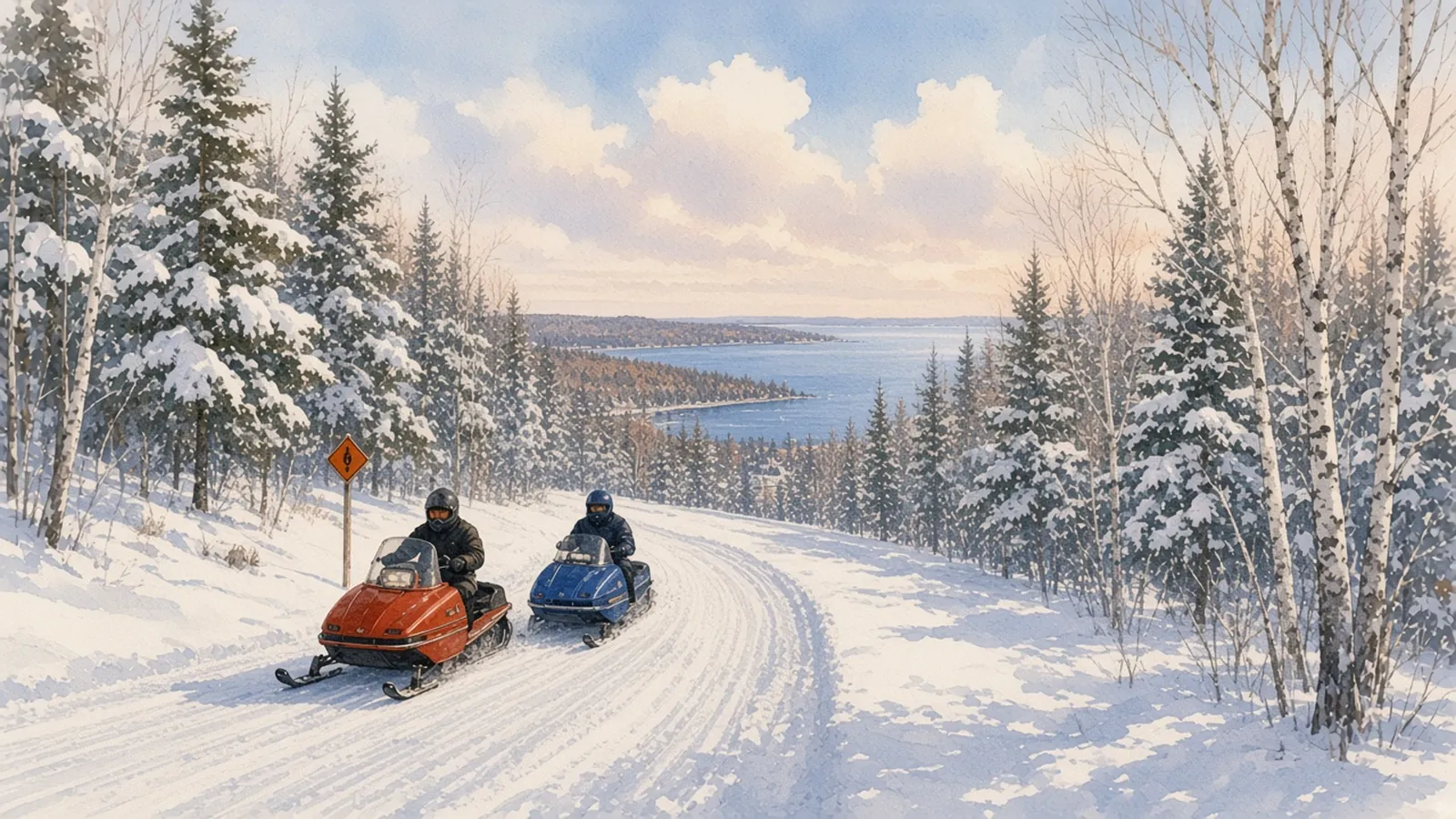
The Upper Peninsula is where Michigan snowmobiling is at its best. Lake Superior's lake-effect snow lands on a network of groomed, signed trails that run from town to town, so you can ride from breakfast in one town to dinner in the next. The Michigan DNR says the state has more than 6,300 miles of designated snowmobile trails, groomed by nearly 70 local clubs. This hub covers what you need to ride legally in 2026–27, the main trail towns, where to get current conditions, and the rules that keep riders safe and keep trails open.
- Our weekly U.P. snowmobile trail report rounds up groomer and visitor-bureau reports from across the peninsula. Weekly editions start when the trails open on December 1.
- Already known for 2026–27: Trail UP8 over the Agate Falls trestle (Bruce Crossing to Kenton) is closed all winter, with a signed reroute.
Permits and registration for 2026–27
Trail permit: $65. Every snowmobile that rides on public land in Michigan needs a trail permit, for residents and nonresidents alike. For 2026–27 the fee rose from $52 to $65, a five-year inflation adjustment that the law requires. The new fee holds for the next five years. A permit covers one season, from October 1 to September 30. Permits go on sale September 1.
- Where to buy: online through the DNR's eLicense system (the sticker arrives by mail in 10 to 15 business days), online from the Michigan Snowmobile and ORV Association (MISORVA, which says mail can take up to 21 days), or in person at DNR license agents and many sled dealers.
- Sticker, not receipt: put the sticker on the front half of the sled, just above or below the headlight. MISORVA warns that a receipt alone is not legal and can get you a ticket. If your sticker won't arrive in time, buy one from a license agent after you get to the U.P.
- Registration is separate. Michigan residents register their sleds with the Secretary of State. Registration lasts three years and expires September 30. Nonresident sleds need a valid registration from their home state or province, or a Michigan registration.
- Exemptions: you don't need a trail permit on your own land. A sled used only to get across the ice for ice fishing is also exempt, but it must still be registered.
- Free Snowmobiling Weekend: for one weekend each winter, the DNR waives the permit and registration on DNR trails. The DNR hasn't announced the 2027 dates yet, so check its page before you plan around it.
When the season runs
State-designated trails are open December 1 to March 31, and the clubs start grooming once there is enough snow. If snow comes early, that doesn't mean grooming starts early, and a thin December means rough trails. January and February are usually the most dependable months. Late-season riding depends on the snow. In 2026 the Keweenaw club ended grooming on April 1, and the Newberry-area association said in late March that its grooming budget was nearly gone.
Hunting seasons overlap the start of the season. The DNR handbook bans riding in areas open to public hunting during the November 15–30 firearm deer season from 7 to 11 a.m. and from 2 to 5 p.m. Tahquamenon Country's visitor guide adds that trails there have limited hours from December 1 to 14 because of hunting seasons. Check local rules before an early-December trip.
Trail maps
- The DNR interactive snowmobile trail map shows designated trails, shared-use trails, closures and parking lots.
- DNR printable maps and GPX/KML files include regional maps for the Western and Eastern U.P. and a map for each county. These geospatial PDFs work offline in apps like Avenza.
- The DNR closures page lists long-term and temporary trail closures. Check it before every trip.
- Local clubs and visitor bureaus sell or hand out paper maps. Trail numbers on the orange diamond markers match the DNR maps.
The main U.P. trail towns
Mileage and snowfall figures below come from each area's club or visitor bureau, and they measure things in different ways. Use them to compare areas, not as exact numbers.
Munising and Alger County
The Munising Visitors Bureau says Alger County has more than 300 miles of groomed trails and averages more than 200 inches of snow a year. The Snowmobile and ORV Association (SORVA) of Alger County grooms them. Trails reach Shingleton, Grand Marais, Seney, Marquette, Chatham, Manistique and Rapid River. Trails 8 and 422 lead to Miners Castle in Pictured Rocks National Lakeshore. The National Park Service says park roads other than Sand Point Road go unplowed and become designated snowmobile trails from December 1 to March 31, so check park rules before you ride there (see our winter guide). See our Munising guide and where to stay in Munising.
Newberry, Paradise and Tahquamenon Country
The Tahquamenon Area Snowmobile Association grooms about 128 miles around Newberry. The best-known ride is Trail 45, the Charcoal Grade, which runs 44 miles from Newberry to Paradise through Tahquamenon Falls State Park. Stop there to see the Upper and Lower Falls in winter. From Paradise, Trail 8 follows the Lake Superior shore toward Grand Marais, about 80 miles, with side trips to the grounds at Whitefish Point and Crisp Point. Tahquamenon Country also lists Trail 9/431 from Newberry to Seney (about 45 miles) and Trail 9 to Pine Stump Junction (19 miles). See Newberry, Paradise, where to stay in Paradise and our Tahquamenon Falls guide.
Seney and Grand Marais
Seney, on M-28 in the central U.P., is linked by trail to both Newberry and Munising, and the Seney Snowmobile Association grooms the local trails. Grand Marais, at the east end of Pictured Rocks, connects to both Munising and Paradise. Expect blowing snow and poor visibility near the Lake Superior shore. See our Grand Marais guide.
The Keweenaw: Houghton to Copper Harbor
The Keweenaw Snowmobile Club grooms about 235 miles of trail from Toivola, south of Houghton, to High Rock Bay at the tip of the peninsula. It runs a fleet of five groomers and grooms most trails every night. Visit Keweenaw puts the average snowfall at more than 270 inches. Parts of the system cross private land, and some gates close at the end of the season. See Houghton, Copper Harbor, and where to stay in Houghton or Copper Harbor.
Ironwood and the Gogebic Range
The Western U.P. Convention and Visitors Bureau counts more than 2,000 miles of groomed trails in the western U.P. The volunteer Gogebic Range Trail Authority runs about 100 miles from the Wisconsin line at Hurley to Marenisco, much of it on old rail grade. Highlights include the Montreal River gorge and Superior Falls. Reports come from the Gogebic Range Trail Authority, Gogebic Area Groomers (Lake Gogebic and Bergland) and the U.P. Thunder Riders. See Ironwood and where to stay in Ironwood.
Marquette County
Local clubs, including the Big Bay 550 Snowmobile Club, groom the Marquette County network, which takes in Ishpeming, Negaunee, Big Bay and Champion. Travel Marquette posts a combined snowmobile and ski conditions page. See Marquette and where to stay in Marquette.
Southern and eastern routes
Trail UP8 crosses the western U.P. through Bruce Crossing. For 2026–27 its Agate Falls trestle section is closed, and the DNR's signed reroute runs south on parts of Trails UP3, UP150 and UP107. Farther east, riders base in Sault Ste. Marie, St. Ignace, Cedarville and on Drummond Island. Each has its own club and report. See our guides to Sault Ste. Marie and St. Ignace.
Where to check trail conditions
The DNR doesn't publish its own grooming reports. It links to outside sources and says it has no control over how accurate or current they are. The most useful U.P. sources are:
- MISORVA groomer reports, posted by each club (Alger, Keweenaw, Gogebic, Tahquamenon, Paradise, Seney and more).
- UP Snowmobiling trail reports by town, written by local reporters, many of them groomers.
- Alger County SORVA trail report (Munising), with a rating for each trail.
- Visit Keweenaw snowfall and trail conditions, with Keweenaw County Road Commission snow totals.
- Western U.P. CVB snowmobile report (Ironwood, Bessemer, Wakefield, Lake Gogebic).
- Travel Marquette trail conditions.
- Exploring the North trail conditions, a list of local report links by town.
We pull these into one weekly trail report, with the date of each source, so you can see at a glance which areas are groomed.
Rules and safety
- Helmets: every driver and passenger must wear a DOT-approved helmet, except on their own private property.
- Lights: the headlight and taillight must be on whenever you ride.
- Ride right: trails carry traffic both ways. Keep to the right, stop completely at every intersection and road crossing, and give way to groomers and to skiers and walkers on shared trails. The DNR says speed is the main factor in snowmobile crashes and deaths.
- Ride sober. In 2022–23 the DNR recorded 204 snowmobile crashes and 19 deaths, and 63% of those deaths involved alcohol or drugs. Riding under the influence also adds points to your driver's license.
- Stay on the marked trail. Much of the network crosses private land by permission. The DNR says more than 400 miles of trail have been lost to noise and trespassing.
- Ice: treat lakes and rivers as unsafe unless a trail is marked across them. Trail-report pages such as Exploring the North regularly warn riders off lakes and rivers because sleds break through.
- Crashes: report any crash that injures someone or causes $100 or more in damage to local law enforcement right away.
- Young riders: children under 12 may ride only under direct adult supervision and may not cross roads. Riders aged 12 to 16 need a snowmobile safety certificate to ride without supervision or to cross a road. The DNR's age chart says the supervising adult must be 18 or older, but its handbook says 21, so plan on 21. Safety courses are offered in classrooms and online.
- Before you leave, share a ride plan with your route and check-in times. Cell service is patchy between towns.
Renting a snowmobile
Several trail towns have sled rentals, and the Munising and Western U.P. visitor bureaus both point riders to local rental outfitters. Some outfitters also run guided rides. When you book, ask:
- Does the rental include the trail permit sticker, helmets and a trail map?
- What is the damage deposit or insurance, and what does it cover?
- Is there a mileage or fuel policy, and what is the age minimum for drivers?
- Is it guided or self-guided, and does it come with a briefing for first-timers?
Holiday weeks and February weekends book up early. Read our first U.P. snowmobile trip guide for gear and planning.
Snowmobile events this winter
- Mt Zion Snocross National, Ironwood (December 2026)
- Snowmobile the Mighty Mac, an antique sled crossing of the Mackinac Bridge (December 2026)
- MIRA EUP Merchants 300, Kinross (January 2027)
- I-500 Snowmobile Race, Sault Ste. Marie (January 31 – February 6, 2027)
- Snowsfest, Les Cheneaux Islands (February 2027)
- Top of the Lake Snowmobile Show & Ride, Naubinway (February 2027)
Ice fishing, dog sledding and saunas fit well around a ride. See winter in the Upper Peninsula, ice fishing and dog sledding. Browse places to stay for trail-side lodging.
Frequently asked questions
How much is a Michigan snowmobile trail permit for 2026–27?
The trail permit costs $65 for 2026–27, up from $52, and the fee stays the same for five years. It is valid from October 1 to September 30. Buy it through DNR eLicense, MISORVA or a license agent, and put the sticker on the sled. A receipt alone is not legal.
When do U.P. snowmobile trails open?
State-designated trails are open December 1 to March 31. Clubs start grooming once there is enough snow, so conditions in early December depend on the weather. January and February are usually the most dependable months.
Do out-of-state riders need a Michigan registration?
No. A nonresident sled needs a valid registration from its home state or province, or a Michigan registration. Every sled also needs the Michigan trail permit sticker.
Where can I check current trail conditions?
Our weekly trail report rounds up the main U.P. sources. For the latest word, check the club groomer reports on MISORVA, UP Snowmobiling's town reports, Alger County SORVA, Visit Keweenaw and the Western U.P. visitor bureau.
Is the trail over the Agate Falls trestle open this winter?
No. The DNR closed Trail UP8 between Bruce Crossing and Kenton for the 2026–27 season because of repairs to the trestle footings. A signed reroute runs south on parts of Trails UP3, UP150 and UP107. Repairs are expected in 2027.
Can kids drive a snowmobile in Michigan?
Children under 12 may drive only under direct adult supervision and may not cross roads. Riders aged 12 to 16 need a snowmobile safety certificate to ride without supervision or to cross a road.
Sources
- Michigan DNR, Snowmobiling (6,300+ miles, Dec. 1 – Mar. 31 season) and Purchase permit, learn requirements ($65 permit, registration, exemptions, nearly 70 grooming clubs), checked Oct 29, 2026.
- Michigan DNR, Required five-year CPI adjustment prompts change in snowmobile trail permit fees (May 11, 2026).
- Michigan DNR, Snowmobile trail over Agate Falls in Ontonagon County to be closed this winter (Oct 20, 2026).
- Michigan DNR, Snowmobile Handbook, Age restrictions and safety certificate, Safe ORV and snowmobile riding, Free Snowmobiling Weekend and Find trail reports.
- MISORVA, Michigan Snowmobile Trail Permit and Groomer Reports.
- Munising Visitors Bureau, Snowmobiling and Munising is Michigan’s best snowmobiling town.
- Tahquamenon Country, Snowmobiling in Newberry and Plan the best snowmobile vacation.
- Visit Keweenaw, Snowmobiling and Snowfall and trail conditions; Keweenaw Snowmobile Club.
- Western U.P. CVB, Snowmobiling; Gogebic Range Trail Authority, Trail info.
- Travel Marquette, Snowmobiling; UP Snowmobiling, Trail Reports.
- Hours, fees, road conditions, and access change — verify with the managing park or visitor bureau close to departure.
- Cell service is thin across much of the peninsula. Download offline maps and tell someone your route.